Understanding the Pinnacle of Archipelagic Travel
The Galápagos Islands are no longer a "roughing it" destination, but the gap between "premium" and "ultra-luxe" remains vast. While a first-class cruise offers comfort, a private yacht charter provides total temporal and spatial sovereignty. In this context, luxury isn't defined by gold-plated fixtures; it is defined by the ability to arrive at Fernandina’s Punta Espinosa thirty minutes before the crowds, or having a PhD-level mycologist as your personal guide.
From a practical standpoint, the Galápagos National Park (GNP) regulates every movement. A private charter allows for a customized itinerary—within GNP limits—that prioritizes your specific interests, whether that is underwater photography at Darwin and Wolf or avian research on Genovesa. For example, a family recently chartered the Aqua Mare to focus exclusively on the "Big 15" endemic species, successfully spotting 14 in seven days due to a flexible, captain-led navigation strategy that larger vessels cannot replicate.
Current data shows that while there are over 65 licensed "tourist" vessels in the islands, fewer than 10 qualify as true ultra-luxury private yachts. In 2025, demand for these vessels increased by 22%, as travelers pivot away from 100-passenger ships toward intimate, 16-passenger platforms that offer a 1:8 or even 1:4 guide-to-guest ratio.
The Critical Role of Vessel Class and Tonnage
In the Galápagos, size dictates access. Yachts like the Theory or Origin (part of the Ecoventura fleet) are designed with a shallow draft, allowing them to anchor in secluded coves where larger ships are prohibited. A 140-foot motor yacht offers the stability of a larger ship but the maneuverability of a coastal cruiser, ensuring a smoother ride through the occasionally turbulent waters of the Itabaca Channel.
Expertise Beyond the Standard Naturalist
Every boat has a guide, but ultra-luxe charters provide "Level 3" naturalists. These are professionals with decades of field experience, often contributing to the Charles Darwin Foundation. Having a guide who can explain the genetic divergence of the lava lizard across different islands in layman's terms transforms a vacation into a masterclass in evolutionary biology.
The Gastronomy of the Equator
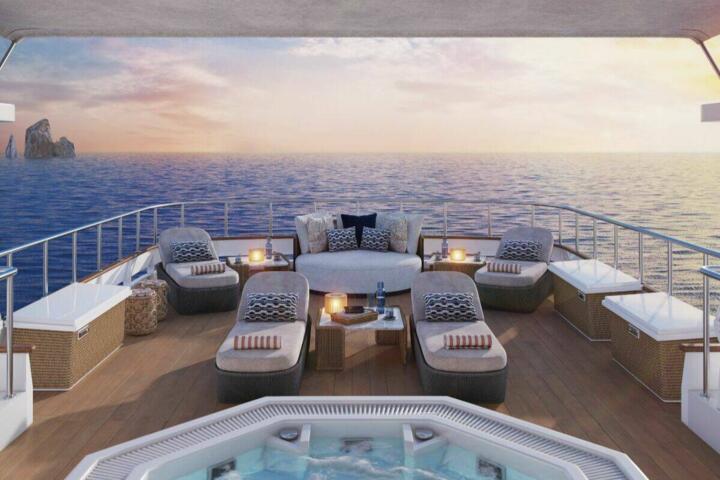
On a private expedition, the culinary experience is bespoke. High-end yachts like the Endeavor II employ Le Cordon Bleu-trained chefs who source 80% of their ingredients locally. Imagine a tasting menu featuring Galápagos lobster and organic highland coffee, paired with a wine cellar stocked with vintage Chilean and Argentinian malbecs, served on a sun deck as the sun sets over the Kicker Rock.
Logistical Fluidity and Private Aviation
The journey begins before you hit the water. True luxury expeditions bypass the chaotic public terminals at Baltra (GPS). Guests are met on the tarmac and whisked to private VIP lounges. Some operators now coordinate with private jet firms like NetJets or VistaJet to sync arrivals directly with yacht boarding, eliminating the 4-hour "dead time" typical of standard tours.
Seclusion as the Ultimate Commodity
The most significant advantage of a private guide and yacht is "buffer time." Standard cruises operate on a 15-minute whistle-stop schedule. On a private charter, if your group is mesmerized by a pod of Orcas hunting off the coast of Isabela, the captain has the authority to linger. This flexibility is the difference between seeing the islands and experiencing them.
Common Failures in High-End Expedition Planning
The most frequent mistake is assuming that price equals privacy. Many "Luxury Suites" on 100-passenger ships still require you to follow a rigid group schedule, eat at set times, and share zodiacs with strangers. This creates a "bottleneck" experience at popular sites like Gardner Bay, where the feeling of isolation is lost to the chatter of forty other tourists.
Another pain point is the "Last Minute" trap. The Galápagos operates on a strict permit system. If you book a private yacht six months out, you are often stuck with the leftover itinerary slots. High-tier explorers often book 12 to 18 months in advance to secure the "Western Loop" (Isabela and Fernandina), which is widely considered the most pristine and volcanically active route.
Lastly, travelers often underestimate the physical demand. Without a private guide to calibrate the pace, older travelers or those with limited mobility may find the rocky terrain of Santiago Island punishing. A private guide can pivot the day’s activities to deep-water snorkeling from the panga (zodiac) rather than a strenuous hike, ensuring no one misses the wildlife.
Strategic Recommendations for a Flawless Expedition
To achieve a true ultra-luxe experience, you must look beyond the thread count of the linens. Focus on the Galápagos National Park Service (GNPS) itinerary cycles. Yachts operate on 15-day cycles, usually split into 7-day "A" and "B" routes. For total immersion, book the full 15-day "back-to-back" charter. This eliminates any overlap and ensures you see every major ecological zone, from the red sands of Rabida to the lush highlands of Santa Cruz.
Insist on a "Specialized Adventure Gear" audit. Ultra-luxe charters should provide high-performance equipment. This includes 7mm Cressi wetsuits (crucial for the cold Humboldt current), Carbon-fiber trekking poles, and polarized Zeiss binoculars for every guest. If a yacht asks you to bring your own snorkel mask, it is not an ultra-luxe operation.
Leverage the Quasar Expeditions model of using "safari-style" land Rovers for highland excursions. Instead of a cramped bus, a private vehicle allows you to visit the giant tortoise reserves or the Twin Craters at your own pace. This "land-to-sea" continuity is what defines a seamless expedition. The result is a 40% increase in wildlife sightings and a 100% decrease in "tourist fatigue."
Mini-Case Examples: Success in the Archipelago
Case Study 1: The Multi-Generational Legacy Trip
A family of 12 chartered the Grace (a yacht once owned by Princess Grace of Monaco). The challenge was satisfying ages 8 to 82. By employing two private guides instead of one, the operator split the group daily: the younger generation went power-snorkeling with sea lions, while the elders took a slow-burn photography walk to see Blue-footed Boobies.
Result: 100% satisfaction rating and the successful documentation of all "Big 15" species without a single injury or "bored" day.
Case Study 2: The Professional Photography Solo Mission
A National Geographic contributor chartered a smaller, 12-passenger yacht for a 14-day private shoot. By negotiating a specific permit for "night-sky photography" in the highlands, the expedition captured rare footage of the volcanic activity on Fernandina.
Result: The flexibility of a private captain allowed the vessel to move 20 miles off-course to follow a rare whale shark sighting, a feat impossible for a scheduled cruise.
Private Yacht vs. Luxury Cruise Comparison
| Feature | Ultra-Luxe Private Charter | Standard Luxury Cruise (40-100 pax) |
|---|---|---|
| Itinerary Flexibility | High (Adjustable within GNP slots) | Zero (Fixed schedule) |
| Guide-to-Guest Ratio | 1:4 or 1:8 (Personalized) | 1:16 (Standard) |
| Dining | A-la-carte / Private Chef | Buffet or Fixed Menu |
| Zodiac (Panga) Access | Immediate / No waiting | Staggered groups (20-40 min wait) |
| Privacy | Total (Only your party) | Shared public spaces |
Frequent Pitfalls and How to Sidestep Them
Do not ignore the "Tipping Myth." In the Galápagos, it is customary to tip the crew and guide separately. On a private charter, this can be 5-10% of the charter fee. To avoid awkwardness, have your concierge handle this through a wire transfer post-trip. Also, beware of "Hybrid" boats. Some vessels claim to be yachts but are actually converted fishing boats with a fresh coat of paint. Look for purpose-built expedition yachts with stabilizers.
Check the "Age of Refurbishment." The salt air is brutal. A yacht built in 2018 that hasn't been dry-docked in three years will show significant wear. Always ask for the date of the last interior and mechanical refit. Top-tier brands like Silversea (Origin/Theory) or Aqua Expeditions maintain rigorous annual maintenance schedules that ensure the AC and desalinization systems (water makers) never fail.
Frequently Asked Questions
1. Is a private charter worth it for only 4 people?
Yes, if your priority is photographic silence and schedule control. While you pay for the full 16-passenger capacity, the intimacy and ability to dictate the daily flow are unparalleled.
2. Can I fly a private jet directly to the islands?
Direct international flights are not permitted. You must clear customs in Quito (UIO) or Guayaquil (GYE). However, you can charter a private jet for the leg from the mainland to Baltra or San Cristobal.
3. What is the best month for a private expedition?
December to May offers warmer waters (25°C) and calmer seas, ideal for snorkeling. June to November is "Garua" season, cooler but better for seeing active sea bird colonies and whales.
4. Are there "No-Fly" zones for drones?
Drones are strictly prohibited in the Galápagos National Park for tourists. Only professional film crews with expensive, pre-approved permits (taking months to acquire) may use them.
5. How do I ensure my yacht is eco-friendly?
Look for "Smart Voyager" certification and yachts using hybrid electric propulsion or advanced wastewater treatment systems to protect the delicate marine ecosystem.
Author’s Insight
In my years of evaluating equatorial expeditions, I’ve found that the most "luxurious" moment isn't the champagne—it’s the silence. On a 100-passenger ship, you are always surrounded by the hum of crowds. On a private yacht like the Elite or Endeavor, you can sit on the bow at 5:00 AM with a coffee and hear nothing but the blow of a tortoise or the splash of a penguin. My best advice: hire a guide who has a background in biology, not just tourism. It changes your entire perspective on the "Enchanted Isles."
Conclusion
An ultra-luxe expedition to the Galápagos is an investment in access and education. To ensure the highest ROI, prioritize a private yacht charter over a large-ship suite, secure your permits at least a year in advance, and insist on a Level 3 naturalist. By controlling the logistics, you move from being a spectator to a participant in one of the world's last true wildernesses. For your next step, vet your vessel’s recent maintenance logs and demand a customized shore-excursion plan that aligns with the specific migratory patterns of the season.