Strategic Access: Why Vertical Lift Redefines the Outback
The Kimberley is roughly the size of California but contains fewer than 15,000 kilometers of paved roads. For the discerning traveler, the "Great Northern Highway" is often a bottleneck rather than a gateway. Private helicopter charters, utilizing machines like the Eurocopter EC130 or the Bell 407, transform a grueling 12-hour dusty drive into a 45-minute scenic transfer.
In practice, this means landing directly at a site like Montgomery Reef as the tide retreats—a phenomenon where the ocean appears to fall away, creating hundreds of cascading waterfalls. Without a helicopter, this is a multi-day maritime expedition; with one, it is a morning excursion from a base like Kununurra or Broome.
The region’s scale is difficult to fathom without data. For instance, the Mitchell Falls (Punamii-unpuu) is a four-tiered waterfall system that requires a 6-hour hike or a 4-wheel drive trip that is frequently closed due to late-season rains. A private lift provides access 365 days a year, regardless of road washouts.
The Critical Errors in Remote Itinerary Planning
The most common mistake travelers make is underestimating the "Wet Season" (November to April) and overestimating the reliability of ground transfers. Many rely on self-drive 4WD rentals, only to find that the Gibb River Road is closed or that their vehicle lacks the snorkel depth for river crossings like the Pentecost River.
Another failure point is "point-to-point" fatigue. Attempting to see the Kimberley via commercial regional flights often results in 80% of the time spent in transit lounges and 20% in the field. This imbalance ruins the "luxury" aspect of the experience, replacing serenity with logistics-induced stress.
Finally, there is the issue of "Visual Noise." Group tours often follow a rigid flight path that limits the time spent at sensitive sites like the Gwion Gwion (Bradshaw) rock art galleries. When you are on a fixed schedule with 10 other people, you lose the ability to linger when the light hits a canyon wall at the perfect angle for photography.
Expert Recommendations for Seamless Aerial Integration
Selecting the Right Airframe for Terrain
Not all helicopters are created equal for the Kimberley heat. Pilots prefer the Airbus H130 for luxury charters because its Fenestron tail rotor is quieter and safer for landing in tight gorges. It also features "theatre seating," ensuring every passenger has an unobstructed view of the Bungle Bungle Range. If you are traveling as a couple, the Robinson R44 is cost-effective, but for groups of 4 or more, the H130 or Bell 206 LongRanger is the industry standard for comfort and payload capacity.
Timing the Tidal Cycles
The Kimberley has some of the largest tidal ranges in the world, reaching up to 11 meters. To see the Horizontal Falls properly, your pilot must coordinate with the lunar cycle. Expert operators like HeliSpirit or Aviair use sophisticated tidal charts to ensure you arrive at the "peak flow" window. Scheduling your flight for a "Neap Tide" will result in a stagnant experience; you want "Spring Tides" for maximum velocity through the gaps.
Utilizing Heli-Fishing and Remote Picnics
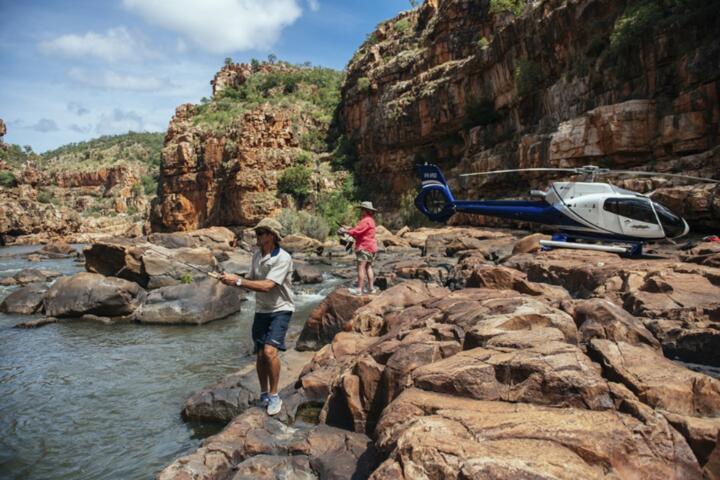
The ultimate use of private lift is reaching "virgin" fishing spots. Helicopter-based Barramundi fishing allows you to land at billabongs that haven't seen a human in months. Operators provide high-end gear and gourmet catering, turning a sport into a five-star dining experience. Look for packages that include "The Eagle’s Nest" landings—spots on high plateaus accessible only by air—for a sunset drink that no ground-based traveler can replicate.
Integrating Luxury Coastal Lodges
Use your helicopter as a shuttle between ultra-remote lodges. Places like Berkeley River Lodge or Kimberley Coastal Camp have no road access. By booking a private transfer, you eliminate the need for long boat transfers through choppy waters. This allows for a "hub and spoke" itinerary where you stay at one luxury base but explore 500 miles of coastline during the day.
Cultural Immersion via Aerial Scouting
Work with operators who have established relationships with Traditional Owners. Private charters can often arrange for a local guide to meet the helicopter at a remote landing strip. This provides an ethical and deep-dive look into Aboriginal history, explaining the Wandjina motifs that predate the Egyptian pyramids. The flight itself becomes a tool for understanding the "Songlines" of the landscape from a perspective that ground travel simply cannot offer.
Logistical Triumphs: Real-World Scenarios
Case Study: The 48-Hour Executive Sprint
A corporate group needed to see the Kimberley but only had a weekend window. Traditionally, this is impossible. We coordinated a private jet arrival into Kununurra, followed by an immediate helicopter transfer to a private camp near the King George River. By utilizing aerial scouting, they visited the Twin Falls, Montgomery Reef, and the Bungle Bungles in 36 hours. A ground-based itinerary would have covered less than 10% of that area.
Case Study: The Photographic Expedition
A professional landscape photographer required specific "Golden Hour" shots of the Cockburn Range. Using a private charter with "doors-off" capabilities, the pilot was able to hover at precise coordinates determined by light-tracking software. The result was a portfolio of images that won international awards, achieved because the pilot could maneuver into angles impossible for fixed-wing aircraft or drones restricted by local park regulations.
Operational Comparison: Private vs. Shared Access
| Feature | Standard Group Tour | Private Helicopter Charter |
|---|---|---|
| Departure Time | Fixed (usually 6:00 AM) | Bespoke / On-demand |
| Route Flexibility | Predetermined flight paths | Fully customizable based on weather/interest |
| Landing Sites | Designated public pads only | Private lodges, remote peaks, "secret" spots |
| Photography | Through plexiglass windows | Doors-off options / Hovering capability |
| Privacy | Shared with up to 12 strangers | Exclusive to your party |
Common Pitfalls to Avoid
Do not book your helicopter flights as "stand-alone" items. They should be integrated into your lodge bookings to ensure luggage weight limits are respected. Helicopters have strict Weight and Balance (W&B) requirements. Standard suitcases often won't fit in the small bays; you must use soft-sided duffel bags. Many luxury travelers arrive with hard-shell Rimowa cases only to find they must leave them at the hangar.
Avoid booking "short" 15-minute scenic loops. In the Kimberley, the first 10 minutes are often spent just clearing the airport perimeter. To truly experience the depth of the red-rock canyons, look for "Mission Profiles" of at least 60 to 90 minutes. This allows the pilot to drop the altitude and follow the river snakes where the wildlife—crocodiles and jabirus—is actually visible.
Frequently Asked Questions
What is the best month for a helicopter safari?
May and June are the "sweet spots." The waterfalls are still pumping from the wet season, the landscape is vibrant green, but the humidity has dropped, and the air clarity is perfect for photography.
Can we land anywhere we want in the Kimberley?
No. Landing requires permits from National Parks or permission from Pastoral Stations and Traditional Owners. Private charters handle these "Landing Fees" and permissions in advance, ensuring you aren't trespassing on sacred ground.
Is it safe to fly during the "Wet Season"?
Yes, but flexibility is key. Pilots monitor weather radar closely. Flights might be delayed by an hour to let a tropical cell pass, but the reward is seeing the Kimberley in its most powerful, electric state with lightning on the horizon.
What should I wear for a private flight?
Avoid loose hats or scarves which can be a hazard near rotors. Wear dark-colored clothing to minimize reflections on the helicopter windows, which is crucial if you are taking photos from inside the cabin.
Are there age or mobility restrictions?
One of the best parts of private lift is that it makes the outback accessible to those who cannot hike. Most helicopters can accommodate passengers with limited mobility, providing a "throne" in the wilderness without the physical toll of trekking.
Author’s Insight
After a decade of navigating the Australian North, I’ve realized that the Kimberley is a vertical landscape. When you are on the ground, you see the trees; when you are in the air, you see the geology. My personal recommendation is to always ask your pilot for a "low-level transit" over the Pentecost River—it’s the only way to truly appreciate the scale of the saltwater crocodiles that inhabit those waters. A private flight isn't just a transport method; it is the only way to see the "veins" of the continent.
Conclusion
Maximizing a journey through the Kimberley requires moving beyond the limitations of the road. By investing in private helicopter logistics, you gain access to the 95% of the region that remains untouched by tourism. Focus on airframe selection, tidal timing, and integrated lodge transfers to ensure your experience is as seamless as it is spectacular. The Kimberley is waiting, but its best secrets are only visible from 1,000 feet above.