Beyond the Tracks: Understanding the African Luxury Rail Landscape
Luxury rail in Southern Africa isn't just about transport; it is a meticulously preserved ecosystem of hospitality that competes with five-star boutique hotels. While many travelers assume these experiences are interchangeable, they operate on fundamentally different models. One prioritizes speed, modernity, and "a hotel on wheels" feel, while the other focuses on historical immersion and slow-travel storytelling.
To understand the scale, consider that the journey between Pretoria and Cape Town covers approximately 1,600 kilometers. These trains navigate the Cape Gauge (1,067 mm) tracks, often sharing lines with freight, which requires sophisticated scheduling. In a typical year, these services contribute significantly to the luxury tourism sector, with ticket prices often starting at $1,500 and scaling past $5,000 per person depending on the suite tier.
A key practical example is the "Off-Train Excursion" model. On the Pretoria–Cape Town run, stops in Matjiesfontein or Kimberley aren't just photo ops; they are timed windows that require the train to manage strict logistics with local heritage sites. Understanding these movements is vital for travelers who value ground-time as much as track-time.
The Common Pitfalls of High-End Rail Planning
The most frequent error travelers make is treating these trains as "fast" transit. Attempting to use a luxury train to meet a tight business meeting in Cape Town is a recipe for frustration. These lines are subject to Transnet (South African freight utility) delays. If a freight locomotive breaks down on the line, the luxury train waits. Viewing the schedule as a "suggestion" rather than a flight itinerary is crucial for mental peace.
Another pain point is the "Packing Paradox." Many guests pack for a safari, forgetting that these trains enforce strict evening dress codes. Walking into a Victorian-era dining car in khakis and hiking boots creates a social friction that can dampen the experience. Conversely, over-packing for a tiny cabin leads to cramped living quarters, as even the most expensive suites have physical limits dictated by the rail gauge.
Finally, there is the issue of connectivity. High-profile executives often board expecting seamless 5G or Starlink-level speeds. In reality, the Karoo desert is a connectivity dead zone. Failing to set "Out of Office" replies leads to a stressful 48 hours of hunting for a signal rather than enjoying the $800 bottle of vintage Kanonkop Cabernet Sauvignon included in your fare.
Strategic Selection: Matching Travel Style to Service
The "Five-Star Hotel" Philosophy of The Blue Train
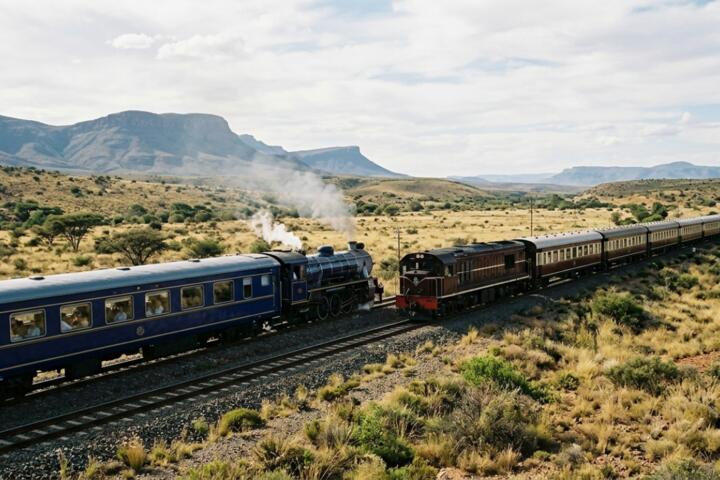
The Blue Train operates like a contemporary luxury hotel. It features modern suspension systems that allow for speeds up to 90 km/h, making it the smoother ride. If you value a bathtub on a train—a feat of engineering involving massive localized water tanks—this is your choice. The service is "Kingsize," focused on efficiency and sleek, polished finishes.
The "Vintage Immersion" Model of Rovos Rail
Rovos Rail is often called the "Pride of Africa," and for good reason. It uses refurbished rolling stock, some dating back to the 1920s. There are no televisions on board, and the use of electronics in public areas is discouraged. It’s a period piece. The engines are often steam-powered for the final leg into the station, providing a sensory experience of soot, whistle, and history.
Suite Engineering and Spatial Dynamics
In the Blue Train's De Luxe suite, you’ll find Murphy-style beds that fold away to create a lounge during the day. Rovos Rail’s Royal Suites take up half a carriage (approx. 16 square meters) and feature permanent side-by-side beds. If you suffer from claustrophobia, the architectural layout of the Rovos Royal Suite is the industry benchmark for space.
Culinarily Considerations and Local Sourcing
Both trains utilize world-class chefs, but the approach differs. The Blue Train often leans toward modern international fusion with South African accents. Rovos Rail leans into traditional "safari-chic" cuisine—expect game meats like springbok or ostrich paired with flagship blends from the Stellenbosch region. Both offer 24-hour butler service, but the ratio of staff to guests is often higher on Rovos, hovering around 1:3.
Route Diversity Beyond the Cape
While both run the Pretoria-Cape Town gauntlet, Rovos Rail wins on geographic reach. They offer epic 15-day treks to Dar es Salaam and "Golf Safari" loops. The Blue Train has historically been more limited, focusing on the core South African corridor, though they occasionally offer extensions to Hoedspruit for Kruger National Park access.
Logistical Execution: A Comparative Case Study
Case 1: The Multi-Generational Family Reunion
A family of six (ages 12 to 75) wanted a scenic transition from a Cape Town stay to a safari in the north. They chose The Blue Train. Because of the modern suspension and TV/Wi-Fi availability in suites, the younger members remained engaged, while the grandparents enjoyed the stability of the ride.
Result: 100% satisfaction on comfort; 48-hour transit completed with zero "cabin fever" incidents.
Case 2: The Retiring Historian
A couple celebrating a 40th anniversary sought a "Time Machine" experience. They booked the Rovos Rail 15-day Dar es Salaam journey. By disconnecting from their iPhones and embracing the formal dinners, they described the journey as "living in a novel."
Result: The slow pace (averaging 40-50 km/h) allowed for deep photography of the Great Rift Valley, which would have been missed on a faster service.
Feature Comparison: The Blue Train vs. Rovos Rail
| Feature | The Blue Train | Rovos Rail |
|---|---|---|
| Atmosphere | Modern, Sleek, "Versailles on Wheels" | Edwardian, Nostalgic, "Out of Africa" |
| Max Suite Size | Luxury Suite (approx. 10–11 sqm) | Royal Suite (approx. 16 sqm) |
| Technology | TVs in suites, Wi-Fi available | No TVs, restricted Wi-Fi areas |
| Ride Quality | High-speed suspension (Smoother) | Vintage bogies (More "click-clack" feel) |
| Bathrooms | Full-size gold-fitted tubs in Luxury suites | Victorian claw-foot baths in Royal suites |
| Off-Train Excursions | Standardized (e.g., Kimberley Mine) | Extensive (e.g., Victoria Falls, Safaris) |
Common Mistakes to Avoid
Do not book your connecting flight for the same evening the train is scheduled to arrive. Transnet rail congestion can cause 4–6 hour delays. Always book a "buffer night" in a hotel at your destination city. This ensures that a late arrival doesn't turn a luxury experience into a stressful sprint to the airport.
Avoid ignoring the "Dietary Requirements" section of your booking form. While both trains have incredible kitchens, they are isolated moving vessels. If you require specific Kosher, Halal, or strict Vegan meals and don't notify them 14 days in advance, the chef will be limited by the pantry on board. Precision in pre-trip communication is the hallmark of an expert traveler.
Don't assume the "all-inclusive" nature covers everything. While it covers meals, drinks (including premium spirits), and excursions, it rarely covers French Champagne or external laundry services at stop-overs. Carry a small amount of South African Rand (ZAR) for tipping your personal butler, which is customary and appreciated for exceptional service.
Frequently Asked Questions
Is there a dress code for during the day?
Daywear is generally "smart casual." Think chinos, polo shirts, and comfortable loafers. However, swimwear and flip-flops are generally inappropriate for the lounge and dining cars. Comfort is key, but maintaining the "club" atmosphere is expected.
Can the trains accommodate mobility issues?
This is a challenge. The corridors are narrow. The Blue Train has some modified suites, but wheelchair users will find it difficult to move between cars while the train is in motion. Always consult with the rail line’s medical coordinator before booking if you have mobility constraints.
Which train is better for children?
The Blue Train is generally more kid-friendly due to the presence of TVs and a slightly faster pace. Rovos Rail is designed for quiet reflection; while children are allowed, there are no specific facilities or "kids' clubs" on board. It is a mature environment.
Are the excursions mandatory?
Not at all. If you prefer to stay on board with a book and a glass of South African Chenin Blanc while the other guests tour a diamond mine, you are welcome to do so. The train remains fully staffed during stops.
Is it safe to travel through South Africa by rail?
Both companies operate private, high-security services. The stations used (like the private Rovos Rail Station in Capital Park, Pretoria) are secure. Onboard, your suite has a digital safe, and the trains are monitored by security personnel, making this one of the safest ways to see the country.
Author’s Insight
I have spent years analyzing luxury logistics, and my takeaway is this: The Blue Train is for the traveler who wants to feel like a modern billionaire, while Rovos Rail is for the traveler who wants to feel like a 19th-century explorer. Personally, I find the "click-clack" of the vintage Rovos bogies more authentic, but if I have a looming deadline and need a functional desk and a smooth ride, I choose the Blue Train every time. My biggest piece of advice? Book the "down-run" (Pretoria to Cape Town) to watch the sunrise over the Hex River Valley—it is the single best view in African rail.
Conclusion
Choosing between Africa’s premier rail lines comes down to your preference for era and pace. For modern comforts, tubs, and speed, The Blue Train is the logical choice. For space, history, and a sprawling route map that covers the continent's heart, Rovos Rail stands alone. To maximize your investment, always build in a 24-hour buffer for arrivals and communicate your dietary needs well in advance. Whichever you choose, you are participating in a disappearing form of "slow travel" that remains the most civilized way to witness the African wilderness.