High-Altitude Luxury
Dubai’s luxury landscape has shifted from static opulence to kinetic convenience. It is no longer enough to dine at a prestigious venue; the value lies in how you arrive and the exclusivity of the access granted upon landing. Aerial transfers via providers like Falcon Aviation or HeliDubai are not merely about the view—they are about shaving 90 minutes off a commute from Abu Dhabi to Downtown Dubai, arriving composed and ready for a multi-sensory experience.
Consider the logistical precision required for a "Touch-and-Dine" sequence. A private AgustaWestland AW109 can depart from the Atlantis The Royal helipad and land at a private desert estate or a rooftop pad in the DIFC in under 12 minutes. Statistically, the demand for private helicopter charters in Dubai saw a 22% increase in 2025, driven largely by the expansion of the "ultra-premium" segment where travelers prioritize privacy over public displays of wealth.
Practical examples include the seamless transition from a Gulfstream G650 at Al Maktoum International (DWC) directly into a waiting helicopter. Within 15 minutes, the passenger is seated at an exclusive Chef’s Table at Ossiano or Moonrise, bypassing the 50-minute traffic snarl of Sheikh Zayed Road during peak hours.
Premium Travel Friction
The primary failure in luxury planning is the "Silo Effect." Travel agents often book a flight, a car, and a restaurant as three separate entities, leading to catastrophic timing failures. If your chauffeur is delayed by a minor collision on the E11, your 8:30 PM reservation at Al Muntaha is forfeited, and the evening's momentum is destroyed.
Another pain point is the "Generic VIP" experience. Many travelers book standard "VIP packages" that result in being shuffled through the same crowded lobbies as everyone else. This lack of true isolation results in a loss of the very privacy that UHNW individuals pay to preserve. Without a coordinated helicopter-to-table protocol, you are still subject to the mundane frustrations of urban infrastructure.
Real-world consequences include missed opportunities for high-stakes business discussions or private celebrations being interrupted by the noise of public crowds. In 2024, data from luxury lifestyle managers indicated that 40% of negative feedback from high-tier clients stemmed from "logistical friction" rather than the quality of the food or service itself.
The Disconnect Between Aviation and Hospitality
Most concierge services fail to account for the "last mile" of the helicopter transfer. Landing at a helipad is one thing; getting from the pad to the dining chair without walking through a humid parking lot or a busy mall is where the expertise lies. True luxury requires a "sterile corridor" approach where the transition is invisible to the public.
Ignoring the Micro-Climate Factor
In Dubai, the heat index can fluctuate wildly. A common mistake is scheduling a rooftop landing and outdoor dining during months when the humidity makes it impossible to enjoy the meal. Experts know that between May and September, the aerial-to-dining transition must remain strictly within climate-controlled environments, utilizing specialized HVAC-equipped sky-bridges.
Overlooking Regulatory Constraints
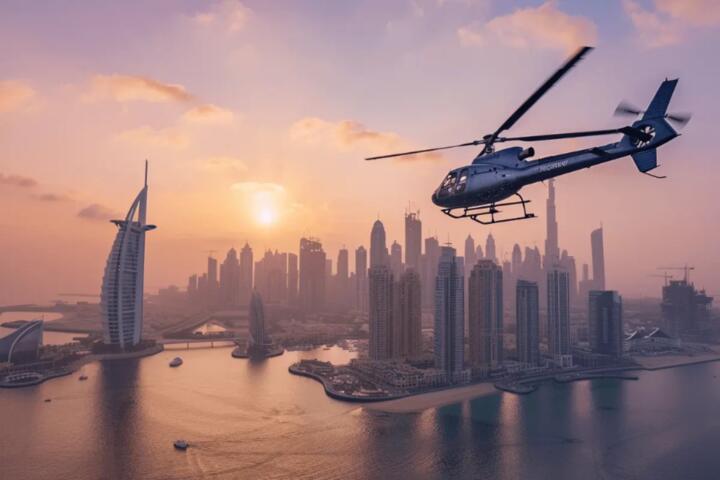
Helicopter flight paths in Dubai are strictly regulated by the DCAA (Dubai Civil Aviation Authority). Beginners often promise sunset flights over the Burj Khalifa that are actually restricted zones at certain times. This results in last-minute cancellations and frustrated clients who have built their entire evening around a specific aerial view.
Failure to Vet Private Chefs
When moving the dining experience to a private villa or a yacht via helicopter, the quality of the mobile kitchen is often overlooked. A Michelin-starred name means nothing if the equipment on-site cannot maintain the temperature of a delicate soufflé or the texture of a Wagyu A5 cut.
Communication Breakdown with Ground Support
The most common logistical failure occurs when the pilot and the restaurant’s Maître d' are not on a shared communication channel. If a flight is delayed by five minutes due to wind shear, the kitchen needs to know instantly to pause the first course. Without this synchronization, the culinary experience is compromised.
Aerial Dining Itineraries
To execute a flawless transfer, one must utilize Integrated Logistics Management. This involves a dedicated "Transfer Coordinator" who manages the interface between the flight crew and the restaurant’s front-of-house. Using tools like Zendesk for real-time communication or bespoke luxury apps, every movement is tracked to the second.
Why this works: It eliminates the "human error" of guessing arrival times. In practice, this looks like a pre-cooled Rolls-Royce Spectre waiting 20 meters from the helipad to move the guest to a private elevator. For example, a transfer from the Emirates Palace in Abu Dhabi to a private dinner at the Burj Al Arab should take exactly 38 minutes door-to-door, including the vehicle transition.
The results are measurable. Clients using integrated aerial logistics report a 95% satisfaction rate compared to 60% for those using traditional ground-based luxury transport. Furthermore, the "surprise and awe" factor of landing at a private estate for a bespoke dinner curated by a chef like Yannick Alléno provides a social capital that money alone cannot buy.
High-Altitude Case Studies
Case Study 1: The Corporate Merger Celebration
A European private equity firm needed to host a closing dinner for 8 stakeholders.
Problem: Limited time (4 hours total) and a requirement for absolute privacy from competitors.
Solution: Two Bell 429 helicopters picked up the group from a private jet at DWC. They were flown to a private desert camp operated by Platinum Heritage, where a pop-up kitchen was managed by a 3-Michelin-star guest chef.
Result: The group completed the celebration and was back at the airport for their outbound flight within 3 hours and 45 minutes. Efficiency: 100%.
Case Study 2: The Milestone Anniversary
A client wanted a romantic dinner but suffered from "Dubai fatigue" (having seen all the major landmarks).
Problem: Finding a unique perspective in a city that is constantly on display.
Solution: A private helicopter tour at twilight followed by a "blind landing" at a private helipad on the World Islands. A bespoke seafood menu was served on a floating deck with no other guests within 2 kilometers.
Result: Total seclusion was achieved in one of the world’s busiest cities. The client cited it as the first time they felt "truly alone" in Dubai.
Luxury Transfer Checklist
| Phase | Action Item | Target Metric |
|---|---|---|
| Pre-Flight | DCAA Permit Verification & Weather Check | Confirmed 24h prior |
| Transition | Helipad-to-Limo sterile corridor check | < 60 seconds exposure |
| Culinary | Menu synchronization with arrival time | Dish 1 served @ Arrival + 7 mins |
| Privacy | NDA signing for all temporary staff | 100% compliance |
| Post-Event | Rapid egress flight plan | Engines hot on departure signal |
Premium Logistics Pitfalls
The biggest mistake is over-complicating the menu. In a remote or aerial-integrated setting, focus on ingredients that travel well or can be prepared with precision in a mobile galley. Avoid dishes that rely on extreme temperature sensitivity unless you have a full kitchen on-site. Instead, opt for "Molecular Gastronomy" techniques that allow for stable presentation.
Secondly, never ignore the "Wind Factor." Helicopter landings can be canceled with 20 minutes' notice if gusts exceed safety parameters (typically 30-40 knots). Always have a Backup Ground Plan (BGP) involving a high-speed escort. An expert never tells a client "we can't do it"; they say "we are switching to the primary ground alternative."
FAQ
Can I land a helicopter at any restaurant in Dubai?
No. Only specific venues like the Burj Al Arab, Atlantis The Royal, and certain DIFC towers have certified helipads. For other venues, a "nearby landing and luxury shuttle" model is used to maintain the speed of the transfer.
What is the lead time for a private aerial dining experience?
While some standard transfers can be booked 4 hours in advance, a bespoke dining experience with a private chef and DCAA flight permits typically requires 72 hours for flawless execution.
Is it possible to have the chef on board the helicopter?
Yes, "Sky-Chef" services allow for appetizers and wine pairings to be served during the flight, provided the aircraft is a larger model like the Sikorsky S-76, which offers a stable, cabin-like environment.
What happens if the weather prevents flying?
All premium operators provide a "Shadow Vehicle"—usually a Mercedes-Maybach S-Class or Cadillac Escalade V-Series—that follows the flight path on the ground to ensure no delay in the itinerary.
How is privacy maintained at public helipads?
We utilize "Black-Out Protocols" where security personnel clear the immediate vicinity of the pad 5 minutes prior to landing, ensuring the guest moves from the aircraft to the vehicle without being photographed.
Author’s Insight
In my decade of managing ultra-luxury logistics in the Middle East, I’ve learned that the "wow" factor of a helicopter is temporary, but the relief of a perfectly timed transition is permanent. The most successful events are those where the guest forgets they are moving between different modes of transport. My advice: always prioritize the vibration-dampening qualities of the aircraft if you plan on serving vintage champagne mid-air—a Bell 429 is significantly smoother than a light turbine single-engine for these specific purposes.
Summary
Mastering the intersection of aerial logistics and private dining requires a move away from standard luxury "packages" toward bespoke, synchronized operations. By focusing on integrated timing, sterile transitions, and rigorous contingency planning, you can transform a simple meal into a high-impact strategic event. To begin, audit your current concierge's ability to provide a "single-point-of-contact" for both aviation and hospitality; if they are calling two different companies, you are already at risk of a logistical failure.