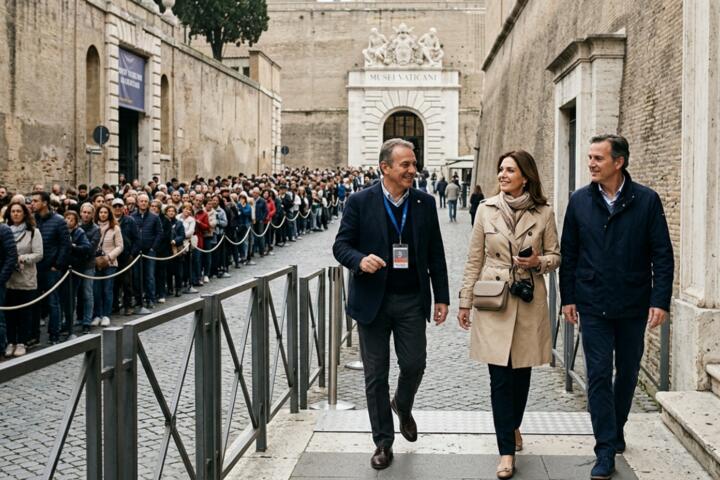
Bespoke Cultural Entry
A private concierge tour is not merely a guided walk; it is a sophisticated logistical operation designed to eliminate friction. In cities like Rome and Paris, the demand for cultural sites far outstrips the physical capacity of the buildings. For instance, the Vatican Museums welcomed over 6 million visitors annually pre-pandemic, with numbers rebounding to near-capacity in 2024 and 2025. Standard "Skip-the-Line" tickets sold on third-party platforms often still involve a 45-minute security wait. In contrast, elite concierge firms utilize "Partner Entrance" status or after-hours keys to guarantee entry within minutes.
Practically, this means while the general public gathers at 7:00 AM for a 9:00 AM opening, a concierge client might meet their expert at a discreet side entrance at 8:00 AM for a "Early Bird" or "Partner Access" slot. This allows for viewing the Sistine Chapel with a dozen people rather than two thousand. These services often employ PhD-level art historians who don't just recite dates but contextualize the geopolitical power of the Papacy or the revolutionary brushwork of Caravaggio.
Statistical data from luxury travel consortia like Virtuoso suggests that travelers using private concierge services report a 40% higher satisfaction rate regarding "educational value" compared to group tours. Furthermore, in peak season (June-August), the temperature inside unconditioned gallery corridors can rise significantly; reducing time spent in these crowds is a matter of physical comfort as much as it is a status symbol.
Costs of Amateur Planning
The most common mistake affluent travelers make is assuming that a "VIP Ticket" purchased on a standard booking site is sufficient. These tickets are often subject to "bottlenecking," where hundreds of "VIPs" arrive simultaneously, creating a secondary line that is just as frustrating as the first. At the Louvre, for example, the Pyramid entrance is a magnet for crowds, regardless of ticket type. Without a concierge who knows the Carrousel entrance or the Portes des Lions schedules, you are still at the mercy of the masses.
Failure to account for "Last Entry" rules and internal gallery closures is another significant pitfall. The Vatican Museums often close specific wings for private functions with little notice. An unassisted traveler might spend hours reaching the Map Gallery only to find their path to the Sistine Chapel blocked. This leads to "museum fatigue"—a documented psychological state where the brain stops processing new information due to physical exhaustion and sensory overstimulation.
Real-world consequences include missed dinner reservations at Michelin-starred restaurants like La Pergola in Rome or L'Ambroisie in Paris because a "quick" museum visit turned into a six-hour ordeal. For a high-level executive or a family on a limited-duration holiday, losing half a day to a queue isn't just an inconvenience; it represents a failure of the itinerary's ROI.
Solutions for Access
Leveraging Direct Curator Networks and After-Hours Access
The gold standard of concierge service is the "After-Hours" tour. Companies like Context Travel or City Wonders offer exclusive access once the general public has cleared out. In the Vatican, this involves the "Clavigero" (Key Keeper) experience, where you participate in the actual opening of the museum doors. This works because it removes the human variable of the crowd entirely, allowing for a silent, contemplative environment that is impossible during standard hours.
Utilizing Secondary and Tertiary Entrances
Expert concierges rarely use the main entrance of the Louvre. Instead, they utilize the Richelieu Wing entrance (reserved for members and specific pass holders) or the Carrousel du Louvre underground access point. By strategically timing the entry to coincide with "lull periods" (often Wednesday or Friday evenings when the Louvre is open late), wait times are reduced by up to 90%. This requires real-time knowledge of museum traffic patterns that only a local professional possesses.
The "Fast-Track" Logistics of Specialized Transport
Getting to the museum is as important as getting in. A concierge ensures a private Mercedes S-Class or V-Class is positioned at the closest possible drop-off point, avoiding the long walks from taxi stands. In Rome, this involves navigating ZTL (Limited Traffic Zones) where standard Ubers cannot go. Services like Blacklane or local boutique firms provide drivers with the specific permits required to reach the Vatican's restricted perimeter, saving an additional 20 minutes of walking in the sun.
Pre-Vetted Academic Guides and "Deep Dive" Curation
To avoid the "information dump" of standard tours, elite services pre-interview clients to understand their specific interests—be it Renaissance sculpture, Egyptian antiquities, or Napoleonic history. For example, a tour of the Louvre focusing strictly on the Denon Wing for Italian masterpieces allows for a deep, 2-hour immersion rather than an exhausting 5-hour marathon. This curated approach ensures cognitive engagement remains high throughout the visit.
Managing "Security Skip" via Diplomatic and Group Credits
While no one can legally skip government-mandated security checks, concierge services utilize "Group Pre-Clearance" lanes that are staffed more efficiently than general lanes. By pre-registering passports and utilizing "Voucher Management Systems" (VMS), the administrative check that takes 15 minutes for a solo traveler is reduced to seconds for a concierge-led party. This is particularly effective at the Vatican, where the security line is the primary cause of delays.
Efficiency Case Studies
Case Study 1: The Multi-Generational Family in Rome
A family of eight, including two elderly grandparents, wanted to see the Vatican Museums during the peak of the July Jubilee.
The Problem: The temperature was 36°C (97°F), and the standard wait time was estimated at 190 minutes.
The Solution: A private concierge arranged a 7:30 AM "Prime Entrance" through a partner agency. They used a specialized elevator access plan to minimize walking for the grandparents.
Result: The family reached the Sistine Chapel 15 minutes after entering, finished the tour in 2.5 hours, and were back at their hotel for a poolside lunch by noon, avoiding the midday heat entirely.
Case Study 2: The Time-Crunched Executive in Paris
A CEO had a four-hour window between a meeting at La Défense and a flight from CDG.
The Problem: He wanted to see the Winged Victory of Samothrace and the Mona Lisa but the Louvre was at 100% ticket capacity.
The Solution: A concierge utilized a "Professional Membership" guest slot and met the client at the Porte des Lions entrance.
Result: Entry took 4 minutes. The guide led a "surgical strike" tour of four specific masterpieces. Total time from drop-off to pick-up: 90 minutes. The client made his flight with time to spare in the lounge.
Protocol Comparison
| Feature | Standard "Skip-the-Line" Ticket | Private Concierge Tour | After-Hours Exclusive Access |
|---|---|---|---|
| Entry Wait Time | 30–60 minutes | 5–10 minutes | 0 minutes |
| Crowd Density | 100% (High) | 70% (Managed) | <1% (Private) |
| Guide Expertise | Generalist / Audio Guide | PhD / Specialist | Senior Curator / Top-Tier Expert |
| Flexibility | None (Fixed Route) | High (Customized) | Total (Access to closed rooms) |
| Cost (Est. Per Person) | $60 – $90 | $250 – $600 | $1,500 – $5,000+ |
Common Mistakes to Avoid
Many travelers wait until they arrive at their hotel to ask the desk clerk for a tour. By this time, the best guides are booked months in advance, and the "Partner" time slots are gone. In Rome, the Vatican Museums release tickets exactly 60 days in advance, and they often sell out within minutes to bots and agencies. A professional concierge service handles this 90 days out, securing the slots before they even hit the public market.
Another error is choosing a tour based on "Length of Time." A 6-hour tour is not necessarily better than a 3-hour tour. In fact, for most visitors, 3 hours is the "saturation point." Expert services focus on the quality of the route—avoiding "backtracking" which is common in the labyrinthine Louvre. If your guide doesn't ask you what you've already seen or what your favorite period of history is, they are providing a commodity service, not a concierge experience.
FAQ
Is it actually possible to skip the security line?
No one is exempt from security screenings (metal detectors and X-rays) for safety reasons. However, concierge services use dedicated entrances where the "security queue" is significantly shorter—often only 2–5 people deep compared to 200–500 in the main line.
What is the best time of day for a private tour in Paris?
While mornings are popular, "Night Openings" (Nocturnes) on Fridays at the Louvre are highly recommended. The lighting on the sculptures is more dramatic, and the crowd levels drop by nearly 50% after 6:00 PM, making the concierge's job of providing an intimate experience much easier.
Can a private guide get me closer to the Mona Lisa?
The Mona Lisa always has a queue within the room. However, a private guide knows the "side flow" and can position you to see the painting from the optimal angle without standing in the central "selfie line" for 30 minutes. They also know which secondary masterpieces in the same room are being ignored by the crowd.
Do these tours include transportation?
Top-tier services like Abercrombie & Kent or Access Italy typically bundle luxury door-to-door transfers. This is crucial because it ensures you arrive at the specific "hidden" meeting point exactly on time, which is difficult when navigating European public transit or unpredictable taxi apps.
Are private tours suitable for children?
Yes, and this is where a concierge shines. They can provide "Kid-Friendly" specialists who use scavenger hunts and storytelling (e.g., the myths behind the statues) to keep children engaged, preventing the "meltdown" that often occurs in crowded, hot museum environments.
Author’s Insight
In my years coordinating luxury travel across Europe, I’ve observed that the difference between a "good" trip and a "transformative" one lies in the first 20 minutes of an excursion. If you start a visit by standing in a humid line, your patience is already thin before you see a single piece of art. I always advise my clients to invest in a "Key Keeper" or "Pre-Opening" tour for the Vatican specifically; the sound of your own footsteps echoing in the Gallery of Maps is a spiritual experience that a standard ticket simply cannot buy. My practical advice: always book your museum concierge before you book your flights.
Summary
Navigating the cultural giants of Europe requires more than just a ticket; it requires a strategy. Private concierge tours provide the logistical precision and intellectual depth necessary to appreciate the Vatican and the Louvre without the debilitating effects of over-tourism. By prioritizing after-hours access, utilizing expert academic guides, and leveraging professional entry points, travelers can ensure their European holiday is defined by inspiration rather than exhaustion. For the best results, engage a concierge service at least three months in advance and insist on a custom-tailored itinerary that reflects your personal curiosities.