The Domestic Sky
Private aviation in the United States is no longer just a luxury; it is a critical productivity tool for navigating "flyover country" where commercial hubs are non-existent. While a flight from Teterboro (TEB) to Van Nuys (VNY) is a standard route, the true value lies in accessing over 5,000 public-use airports compared to the 500 served by scheduled airlines.
In practice, a legal team traveling from Des Moines to a remote site in West Virginia can save 12 hours of transit time by bypassing hub-and-spoke connections. Current data from WingX shows that business jet activity in the U.S. remains 15% higher than pre-pandemic levels, with mid-size cabins seeing the highest demand for transcontinental legs.
Real-world pricing is driven by the "occupied hourly rate," which can range from $3,000 for a turboprop like the Pilatus PC-12 to $12,000+ for a Gulfstream G650. However, the sticker price rarely tells the whole story of the total mission cost.
Operational Pitfalls
The most significant mistake newcomers make is ignoring "deadhead" or repositioning costs. If you book a one-way flight from a remote location, you are often paying for the aircraft to fly empty back to its base. This can inflate the perceived hourly rate by 50% or more without providing any value to the passenger.
Failing to account for Federal Excise Tax (FET) of 7.5% and fuel surcharges is another common oversight. Many digital brokers show "estimated" prices that exclude these mandatory line items, leading to budget overruns during the final invoicing stage. This lack of transparency erodes trust and complicates corporate accounting.
Furthermore, selecting the wrong aircraft class for the mission leads to unnecessary waste. Using a Heavy Jet for a two-hour flight with three passengers is an expensive ego play. Conversely, pushing a Light Jet to its range limit often requires a fuel stop, turning a four-hour direct flight into a six-hour ordeal, defeating the purpose of private travel.
Strategic Solutions
To maximize efficiency, travelers should match their specific mission profile to the right access model: On-Demand Charter, Jet Cards, or Fractional Ownership. Each has a specific breakeven point based on annual flight hours and flexibility requirements.
Leveraging Empty Legs
For flexible travelers, "Empty Leg" flights offer discounts of 50% to 75% off standard charter rates. Using platforms like Wheels Up or XO, users can track aircraft that need to return to base after a one-way drop-off. It works best for spontaneous trips where the destination is a major hub like Miami or Las Vegas.
Fixed-Rate Jet Cards
If you fly between 25 and 50 hours per year, a Jet Card from providers like Sentient Jet or NetJets (via their Marquis Card) provides price predictability. These cards lock in an hourly rate and guarantee availability, which is crucial during "blackout dates" like Thanksgiving or the Super Bowl when charter prices skyrocket.
Fractional Ownership
For those exceeding 50 hours annually, fractional ownership offers the tax benefits of depreciation without the headache of full management. Companies like Flexjet allow you to buy a share (e.g., 1/16th) of a specific tail number. This ensures a consistent cabin experience and highly trained dedicated crews.
The PC-12 Efficiency
In the U.S. domestic market, the Pilatus PC-12 remains the "Swiss Army Knife" of aviation. It operates at roughly $2,800 - $3,500 per hour while carrying 6-8 passengers. For missions under 800 miles, it is often only 15-20 minutes slower than a light jet but costs 40% less.
Using Brokers Wisely
A reputable broker acts as an outsourced flight department. They vet operators for safety ratings (Argus Gold/Platinum or Wyvern Wingman) and negotiate "mechanical recovery" clauses. If your plane breaks down, the broker is responsible for finding a replacement without you paying twice.
Mission Profiles
Consider a tech firm based in Austin needing to visit three manufacturing sites in the Midwest in two days. Using commercial airlines, this itinerary would take four days due to layovers and limited regional schedules. By chartering a Cessna Citation Latitude, they visited all sites and returned home in 36 hours.
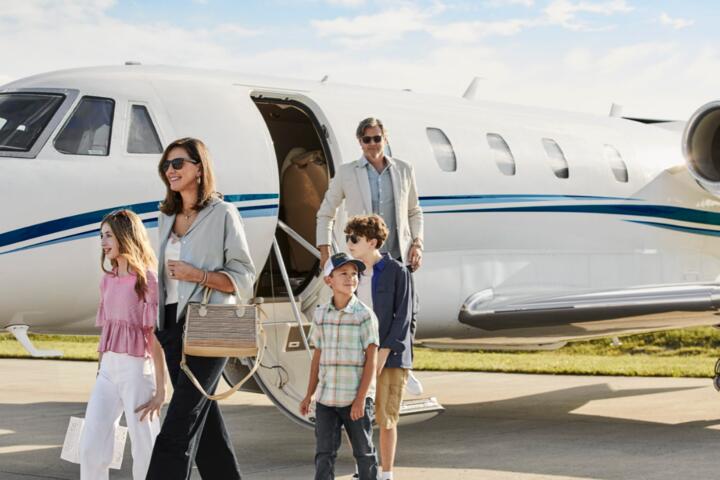
Another case involved a family of five traveling with pets from New York to Aspen. Commercial first class was quoted at $9,000 total, but with rigid schedules and baggage limits. For $28,000, they secured a Super Mid-size jet, flew door-to-door, avoided the chaos of EWR, and saved 5 hours of total travel time.
Charter Comparison
| Aircraft Category | Typical Models | Hourly Rate (Est.) | Pax Capacity | Best Use Case |
|---|---|---|---|---|
| Turboprop | King Air 350i, PC-12 | $2,500 - $4,000 | 6 - 9 | Short regional hops, small runways |
| Light Jet | Phenom 300, CJ3 | $4,500 - $6,500 | 6 - 7 | 2-3 hour missions, high speed |
| Mid-Size Jet | Citation Latitude, Lear 60 | $6,500 - $9,000 | 8 - 9 | Coast-to-coast with one stop |
| Super Mid-Size | Challenger 350, Praetor 600 | $9,000 - $12,000 | 9 - 10 | Non-stop transcontinental trips |
| Large / Heavy | Gulfstream GIV, Global 6000 | $12,000 - $20,000 | 12 - 16 | Large groups, ultimate luxury |
Avoiding Overpayment
To avoid overpaying, always request a "round-trip" quote if you are returning within 24-48 hours. This allows the aircraft to stay with you, eliminating the cost of two separate one-way repositioning legs. Often, the "overnight fee" for the crew is far cheaper than paying for a second empty flight.
Always verify the "Year of Make" (YOM) and "Year of Refurbishment" (YOR). An older aircraft that has been meticulously refurbished in 2022 will offer the same cabin experience as a 2024 model but usually at a lower hourly rate. Don't pay a premium for "new" if the interior is identical.
FAQ
What is the cheapest way to fly private?
The most cost-effective method is booking an empty leg. However, you must be flexible with your timing and have a backup plan, as these flights can be canceled if the primary passenger changes their schedule.
How much does a flight from NY to LA cost?
A one-way flight on a Super Mid-size jet (necessary for non-stop transcontinental range) typically costs between $35,000 and $55,000 depending on the specific aircraft and current fuel prices.
Are there memberships without upfront fees?
Yes, services like Jettly or XO offer "pay-as-you-go" options or small annual membership fees that provide access to their booking platforms without requiring a $100k+ deposit.
Is food and drink included in the price?
Standard "stock" (water, sodas, light snacks) is included. However, high-end catering, hot meals, and specific alcohol brands are usually billed as extra line items after the flight.
Can I bring my dog on a private jet?
Almost always, yes. This is a primary reason many choose private travel. Most operators are "paws-friendly," though some may charge a small cleaning fee for heavy shedding or larger breeds.
Author’s Insight
In my fifteen years advising private flyers, I have found that the "best deal" is rarely the lowest price. I once saw a client save $2,000 on a cheap charter only to be stranded in Teterboro for six hours because the operator didn't have a backup plane when a sensor failed. My advice: always prioritize operators with a large "floating fleet" or brokers with a 24/7 duty desk. Reliability is the only currency that matters when you are paying $6,000 an hour.
Summary
Navigating the U.S. private aviation market requires a balance of mission-matching and financial transparency. To optimize your spend, start by auditing your last twelve months of travel to determine your average stage length and passenger count. Use this data to choose between on-demand charter for variety or a jet card for consistency. Always demand a "fully transparent" quote that includes FET and fuel, and never compromise on safety ratings for the sake of a few hundred dollars. Efficiency in the air starts with diligence on the ground.