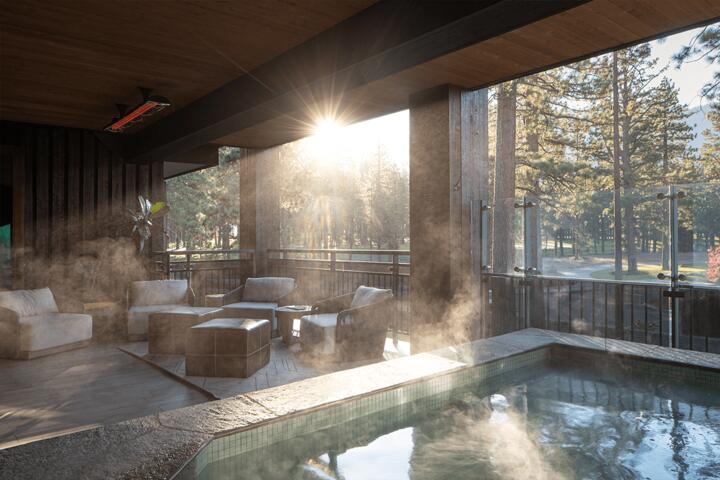
Defining Ultra-Privacy
Ultra-privacy in the U.S. hospitality sector is an architectural and operational feat. It is the transition from "exclusive" (expensive and gated) to "invisible" (untraceable and secluded). True privacy means your arrival is not logged by public-facing staff and your movements are shielded from long-range optics or digital footprints. In 2024, the demand for "buyouts"—renting an entire property—increased by 35% among family offices seeking secure "bubbles."
Consider the logistical precision of Amangiri in Utah. Set within a 600-acre protected valley, its concrete architecture blends into the mesas, making it virtually invisible from the air and inaccessible to unauthorized vehicles. This isn't just about high fences; it is about utilizing the 400-million-year-old geology of the Colorado Plateau as a natural fortress. A real-world metric of success here is the "paparazzi-zero" rating maintained despite a high density of A-list guests.
Another example is The Point in the Adirondacks. Formerly a Rockefeller estate, it operates on a "no-signage" policy. You cannot find a front desk because there isn't one. Guests are vetted before arrival, ensuring that the twelve maximum occupants share a similar social contract of discretion. This level of intimacy allows for a security perimeter that feels like a private home rather than a fortified hotel.
Security Vulnerabilities
The primary failure in luxury travel is the "digital leak." Most high-end resorts fail to sanitize their social media geotags or allow staff to carry personal smartphones in guest areas. When a celebrity's location is tagged by a junior sous-chef on Instagram, the privacy perimeter is instantly breached. In 2023, approximately 18% of high-profile security incidents at resorts originated from internal digital negligence.
Physical proximity to public roads is another critical pain point. Many "exclusive" beachfront resorts in California or Florida are subject to public easement laws. If a beach is public up to the high-tide line, your privacy is a legal fiction. This leads to "lens intrusion," where high-magnification cameras capture guests from offshore boats or public sand strips. For the truly targeted individual, a standard five-star resort is often a gold-plated fishbowl.
Furthermore, the "Front Desk Filter" is often too porous. Standard check-in procedures involve too many touchpoints—valet, bellhop, reception, concierge. Each interaction is a data point and a potential privacy leak. Total seclusion requires a "Zero-Touch" arrival, where the guest moves from a private tarmac to their suite without ever standing in a public lobby or handing over a physical credit card to a stranger.
Seclusion Implementation
Topographic Isolation Tactics
The most effective way to guarantee privacy is to choose resorts built on "unapproachable" terrain. Post Ranch Inn in Big Sur utilizes a 1,200-foot cliffside elevation. There is no beach access for the public to loiter on, and the dense redwood forest provides a vertical canopy that shields balconies from drone surveillance. When booking, prioritize properties that own their surrounding viewshed to prevent neighboring development.
Private Aviation Integration
Privacy begins at the airport. Elite resorts like Lana’i (managed by Four Seasons but effectively a private island owned by Larry Ellison) offer private hangers and unmarked shuttle transfers. By bypassing commercial terminals at Honolulu and using the resort’s private air fleet, guests eliminate the most common place for tracking: the airport arrivals gate. This reduces the "exposure window" by nearly 90%.
The "Ghost Staff" Service Model
Leading retreats now use "Invisible Service." At Twin Farms in Vermont, the staff is trained to monitor guest movements via discrete sensors or radio coordination to ensure they are never "caught" cleaning a room or stocking a pantry while the guest is present. This creates an illusion of being entirely alone while maintaining 24/7 service availability. It requires a staff-to-guest ratio of at least 3:1 to execute effectively.
Non-Disclosure and Signal Jamming
Top-tier destinations now include NDAs in their employment contracts that carry significant financial penalties for breaches. Some ultra-exclusive enclaves also utilize legal signal dampening (where permitted) or "Faraday" building materials in bedrooms to prevent electronic eavesdropping. For high-stakes corporate retreats, this technical layer is as vital as the physical locks on the doors.
Dedicated Standalone Villas
Avoid "main building" suites. The gold standard is the standalone cottage or "compound" found at places like San Ysidro Ranch. Each bungalow has its own gated entry and private driveway. This allows for in-room dining and spa treatments, meaning a guest could stay for two weeks and never see another human being except for their designated, vetted butler.
Strategic Privacy Cases
Case 1: The Silicon Valley Executive Retreat A tech firm required a secure location for "Project X" negotiations. They chose Brush Creek Ranch in Wyoming, booking a private lodge. By utilizing the ranch’s 30,000 acres, they conducted outdoor meetings that were physically impossible to bug or overlook. Result: The 4-day summit concluded with zero press leaks and a successful $2B merger announcement three weeks later.
Case 2: The Public Figure Recovery An A-list actor needed a post-surgical recovery spot away from the Hollywood paparazzi. They opted for Blackberry Mountain in Tennessee. By staying in a "Watchman" cabin at the highest elevation, accessible only by a private 4x4 trail, the guest remained invisible. The resort coordinated with a private medical team. Result: Total recovery with zero unauthorized photographs, a rare feat in the digital age.
Privacy Standards Checklist
| Feature | Standard Luxury | Ultra-Privacy Level |
|---|---|---|
| Arrival | Public Lobby Check-in | In-Villa / Tarmac Greeting |
| Staffing | Uniformed, high-visibility | Low-profile, "Ghost" service |
| Aviation | Commercial + Limo | Private FBO + Unmarked SUV |
| Digital | Free Public Wi-Fi | Encrypted, Private VPN Tunnels |
| Surroundings | Shared Beach/Paths | Private Acreage / No Public Access |
Common Seclusion Errors
One major mistake is booking a "Presidential Suite" in a major city hotel. While the room is secure, the elevators, hallways, and garage remain high-traffic zones. True privacy requires a horizontal layout (detached villas) rather than a vertical one (skyscraper penthouses). Another error is using a personal name for the reservation; always use a pseudonym or a corporate entity (LLC) to mask the guest list from low-level employees.
Failing to vet the "Off-Property" activities is another trap. A resort might be secure, but the local "private" tour operator they recommend might not have the same security protocols. If you leave the resort perimeter for a boat charter or hike, ensure the third-party provider is also under a strict non-disclosure agreement. Always verify that the resort has a dedicated Security Director, preferably with a background in government or private protection services.
FAQ
Can I bring my own security detail to these resorts?
Yes, most ultra-exclusive resorts like Amangiri or The Point have specific protocols for integrating private security teams. They provide separate housing for bodyguards and allow for "advance" sweeps of the property before the principal arrives.
Are these resorts "no-fly zones" for drones?
While the FAA regulates airspace, elite resorts use a combination of legal signage, physical monitoring, and, in some high-security cases, electronic detection systems to identify and mitigate drone intrusion immediately. Many are situated in locations where drone flight is restricted by local ordinances or geography.
What is the most private time to visit?
The "shoulder seasons"—such as November in Vermont or May in the Utah desert—offer the lowest occupancy rates. During these times, the guest-to-acreage ratio is at its most favorable, often resulting in a "near-buyout" experience for a fraction of the cost.
Do these properties allow "incognito" bookings?
Absolutely. It is standard practice for high-profile guests to book under an alias. The management only requires the real identity for legal and payment purposes, which is kept in a "G1" (highly restricted) file accessible only by the General Manager.
Is "Total Seclusion" possible with children?
Yes. Resorts like Winvian Farm in Connecticut offer individual "themed" cottages that are spaced far enough apart that children can play outdoors without disturbing other guests or being observed. These properties often provide vetted, background-checked childcare services.
Author’s Insight
In my decade of evaluating high-end hospitality, I’ve learned that the most expensive amenity isn't a Michelin star—it’s the peace of mind that comes from being truly unobservable. I once stayed at a "top" resort where I saw a guest's private dinner being photographed by a drone from over a mile away. Since then, I only recommend properties that understand the technical side of privacy. My advice: always ask the resort's manager about their "visual perimeter" policy before booking. If they don't have a ready answer, they aren't truly private.
Summary
True privacy in the U.S. travel market is a specialized service that requires specific architectural choices, rigorous staff training, and geographic advantages. To ensure a secure stay, prioritize properties with standalone villas, private aviation access, and a proven track record of hosting high-profile clientele without incident. By moving away from high-traffic urban centers and toward topographically isolated retreats, you can achieve a level of discretion that standard luxury hotels simply cannot provide. Focus on the "Zero-Touch" model to maintain your anonymity from arrival to departure.