Premium Asset Class
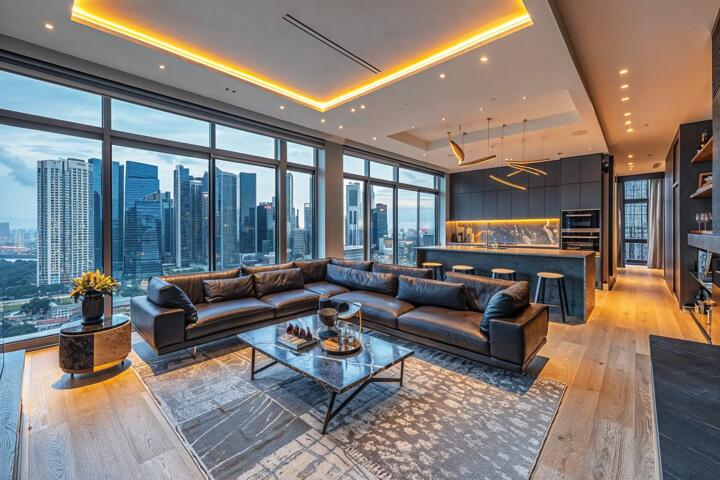
Luxury penthouses in Singapore represent the pinnacle of the city-state's "non-landed" residential market. These assets are defined not just by their elevation, but by their strata area—typically exceeding 3,000 square feet—and their location within prime Districts 9, 10, and 11. As of early 2026, the entry price for a trophy penthouse in the Core Central Region (CCR) has stabilized at approximately S$3,500 to S$5,000 per square foot.
For institutional investors and family offices, these units serve as critical wealth preservation vehicles. Unlike landed properties, which are heavily restricted under the Residential Property Act, penthouses offer a "landed-living" experience with the transactional ease of a condominium. In Q1 2026, Singapore recorded a 1.68% quarter-on-quarter price increase in the luxury segment, reflecting sustained demand despite rigorous cooling measures.
Current market data shows that "Super Penthouses"—units larger than 10,000 square feet—remain the most resilient assets. Brands like Aman Residences and Edition have introduced serviced luxury concepts where the regulatory landscape overlaps with hospitality, requiring specific knowledge of URA's latest "Gross Floor Area" (GFA) harmonisation rules introduced to standardize space measurements.
Regulatory Pain Points
The primary hurdle for luxury penthouse buyers in 2026 is the misalignment between perceived value and statutory costs. Many investors underestimate the impact of the Additional Buyer’s Stamp Duty (ABSD), which currently stands at 60% for foreign nationals. For a S$20 million penthouse, the tax liability alone is S$12 million, payable within 14 days of exercising the Option to Purchase (OTP).
Another common mistake involves the classification of "strata-landed" penthouses. Some luxury developments feature units that appear to be bungalows but are legally strata-titled. While foreigners can generally buy these, certain "cluster housing" projects require specific approval from the Land Dealings (Approval) Unit (LDAU). Failure to secure this clearance before signing a binding agreement can lead to the forfeiture of the 1% or 5% option fee.
Furthermore, the URA’s 2023 GFA Harmonisation Rule has fundamentally changed how developers calculate saleable area. In the past, "void spaces" (high ceilings) were often included in the strata area but not the GFA. In 2026, all areas used for floor slabs are included in GFA, meaning buyers must scrutinize floor plans to ensure they are not paying premium prices for non-functional vertical volume.
Compliance Framework
ABSD Tier Structures
The 2026 tax landscape is progressive. Singapore Citizens pay 20% on their second property and 30% on their third, while Permanent Residents (PRs) pay 5% on their first and 30% on subsequent purchases. Foreigners face a flat 60%. However, under Free Trade Agreements (FTAs), citizens of the USA and nationals/PRs of Switzerland, Norway, Iceland, and Liechtenstein are treated the same as Singapore Citizens for stamp duty purposes.
GFA Harmonisation Rules
Introduced by the URA, the harmonisation rule ensures that the area sold to the buyer is consistent with the area defined for development charge purposes. For penthouses with sprawling roof terraces or private pools, this means "AC ledges" and "void areas" are no longer included in the strata area. Investors should look for 2026-compliant valuations to ensure they are comparing "apples to apples" when evaluating older vs. newer developments.
LDAU Approval Mandates
Under the Residential Property Act, a penthouse is generally considered "non-landed" and thus unrestricted. However, if the development is zoned as "landed" but has a strata title (common in Sentosa Cove), foreigners must apply to the LDAU. The criteria include "exceptional economic contribution" to Singapore. Sentosa Cove remains the only enclave where this approval is fast-tracked for foreign buyers of villas and certain ground-level units.
Financing and LTV Caps
The Monetary Authority of Singapore (MAS) maintains a Loan-to-Value (LTV) limit of 75% for a first housing loan, but this drops significantly to 45% for a second loan. For luxury assets exceeding S$10 million, many banks in 2026 apply even stricter internal "haircuts," often capping LTV at 50% to 60% regardless of the buyer’s credit profile. Total Debt Servicing Ratio (TDSR) remains at 55% of monthly income.
The 30-Month Rule
Permanent Residents looking to upgrade to a luxury penthouse from an HDB flat must navigate the 30-month de-barment period. If you own a private property, you must sell it and wait 30 months before you are eligible to apply for a new HDB flat. Conversely, if you currently own an HDB, you must fulfill the 5-year Minimum Occupation Period (MOP) before acquiring a private penthouse, regardless of your ability to pay the ABSD.
Anti-Money Laundering
In 2026, Singapore has intensified its AML (Anti-Money Laundering) and KYC (Know Your Customer) protocols for real estate. Developers and law firms are required to conduct "Source of Wealth" audits for any transaction exceeding S$5 million. Buyers should prepare three years of audited tax returns or bank statements. Transactions involving "shelf companies" or complex trust structures face heightened scrutiny from the Council for Estate Agencies (CEA).
Global Family Office Case
In mid-2025, a European family office sought to acquire a S$35 million super penthouse in District 10. The initial challenge was the 60% ABSD. However, because the principal was a Swiss national, the legal team successfully applied for FTA remission, reducing the ABSD to 0% for their first Singapore residential property. This saved the client S$21 million in upfront taxes.
The second challenge was the "void space" calculation. The developer’s original 2022 marketing brochure listed the unit at 8,000 sq ft, but under the new URA GFA Harmonisation rules applied during the 2026 completion phase, the functional strata area was recalibrated to 7,400 sq ft. The legal team negotiated a price adjustment based on the net usable area, demonstrating the importance of contemporary regulatory knowledge in contract negotiations.
Investment Comparison
| Profile | ABSD Rate | LDAU Required | Max LTV |
|---|---|---|---|
| Citizen | 0% (1st) | No | 75% |
| PR | 5% (1st) | No | 75% |
| Foreigner | 60% (Flat) | Sometimes | 60% |
| US National | 0% (1st) | No | 60% |
Common Legal Traps
One critical error is the "Nominee" trap. Attempting to use a Singaporean citizen as a nominee to purchase a penthouse and bypass ABSD is a criminal offense under the Residential Property Act. The Singapore government uses advanced data analytics to track "de facto" ownership. If caught, the property can be confiscated, and both the nominee and the actual buyer face imprisonment and heavy fines.
Another oversight is the "Property Tax (Amendment) Act" regarding annual value (AV) assessments. Luxury penthouses often have higher AVs due to their unique features. In 2026, owner-occupied tax rates for properties with an AV above S$100,000 have increased. Investors must budget for annual taxes that can exceed S$20,000, in addition to monthly MCST (Management Corporation Strata Title) fees which, for luxury units with private lifts and concierges, can range from S$1,500 to S$4,000.
Lastly, ensure the "Option to Purchase" contains specific clauses regarding the "Seller’s Stamp Duty" (SSD). If you are buying a penthouse that the seller has held for less than three years, they are liable for SSD (up to 12%). While this is a seller's cost, any legal delay that pushes the "exercise date" could affect the transaction's financial viability or lead to a collapse of the deal if the seller tries to pass the cost to the buyer.
FAQ
Can foreigners buy landed penthouses?
Most penthouses are non-landed residential properties and can be bought freely by foreigners. However, if the penthouse is part of a "landed" development with strata titles (excluding Sentosa Cove), you must obtain LDAU approval, which is granted based on your economic impact on Singapore.
What is the total tax for foreigners?
In 2026, a foreign buyer typically pays 60% ABSD plus a progressive Buyer's Stamp Duty (BSD) of up to 6%. For properties valued over S$3 million, the BSD is roughly 6%. This means you should budget approximately 66% of the purchase price for taxes alone.
Do US citizens get ABSD remission?
Yes. Under the US-Singapore Free Trade Agreement, US Nationals are eligible for the same ABSD treatment as Singapore Citizens. This means 0% ABSD for the first residential property. This also applies to nationals from Switzerland, Norway, Iceland, and Liechtenstein.
How is the strata area calculated now?
Following the 2023 URA harmonisation rule, the strata area must match the GFA. This means AC ledges, large voids, and "extra" structural spaces are no longer included in the saleable square footage. This protects buyers from paying for "air space" that cannot be utilized.
Can I buy via a Trust?
You can, but since 2022, any transfer of residential property into a living trust is subject to an upfront ABSD (Trust) of 65%. While you can apply for a refund if the beneficial owner is a clear, identifiable individual, the liquidity requirement for the upfront payment is a major hurdle.
Author's Insight
I have guided dozens of high-net-worth clients through the evolution of Singapore's cooling measures since 2011. The 2026 market is no longer about speculation; it is about precision. The 60% ABSD for foreigners has shifted the buyer profile toward those seeking generational wealth storage or those who qualify for FTA remissions. My strongest advice is to never sign an OTP without a preliminary "Source of Wealth" check and a confirmed LDAU status check for the specific development. In Singapore, the cost of a technical oversight often exceeds the price of the property itself.
Summary
The Singapore luxury penthouse market in 2026 remains a highly regulated but rewarding asset class. To succeed, investors must navigate the 60% ABSD, leverage FTA remissions where applicable, and understand the URA GFA harmonisation rules to ensure fair pricing. Success requires a multidisciplinary approach involving specialized conveyancing lawyers and tax consultants. Always prioritize "Core Central Region" assets for the best liquidity and ensure all AML/KYC documentation is auditable before initiating a transaction.