Regulatory Tourism Framework
The Maldives continues to operate under a unique legal structure that treats individual coral islands as sovereign economic zones for hospitality. In 2026, the Ministry of Tourism has further refined the "One Island, One Resort" policy while integrating new "Integrated Resort" models that allow for multiple hotels within a single lagoon. This hybrid approach is essential as the nation targets 2.5 million arrivals by the end of the year.
Recent legislative amendments have shifted authority from the Environmental Protection Agency (EPA) to the Environmental Regulatory Authority (ERA), signaling a more centralized approach to development approvals. The goal is to balance the ambitious 2027 "Visit Maldives Year" infrastructure targets with the fragile ecology of the 26 atolls. Currently, over 170 resorts are operational, with an additional 25 in various stages of the 2026 development pipeline.
Developers must now navigate a landscape where 2026 land reclamation permits are increasingly tied to "Sustainable Management Plans" (SMP). These plans are no longer optional suggestions; they are mandatory attachments to the Lease Agreement, requiring specific commitments to renewable energy and waste treatment before the first pilings are driven into the seabed.
Development Friction Points
The most common error international developers make is overestimating the buildable "dry" land on a leased island. In the Maldives, the high-tide line (Mean High Water Mark) is a volatile boundary. Building too close to this line leads to rapid beach erosion, a mistake that cost developers an estimated $120 million in remediation and "hard" coastal engineering works across the Malé Atoll in 2025 alone.
Another critical pain point is the "Vegetation Profile" mandate. Traditional zoning prohibits any structure from protruding above the natural tree line of the island. This creates a vertical limit that often conflicts with the desire for high-density luxury. Failure to adhere to these setbacks and height caps can result in fines of up to MVR 1 million and a permanent stay on further construction permits until the structure is modified.
Environmental Impact Assessments (EIAs) have also undergone a controversial shift. While 2026 amendments have streamlined the process for warehouse and staff accommodation blocks, the scrutiny on lagoon dredging and land reclamation has intensified. Developers who ignore the "live coral cover" statistics during their initial survey often find their reclamation permits denied mid-project, leading to catastrophic capital lockups.
2026 Zoning Requirements
The 20% Built-Up Limit
The cardinal rule of Maldivian resort zoning remains the 20% built-up area limit. This means that for every 100,000 square meters of leased land, only 20,000 square meters can be occupied by permanent structures. This includes guest villas, back-of-house facilities, and public areas. In 2026, the ERA has begun including over-water structures in this ratio if they connect to the island via permanent jetties.
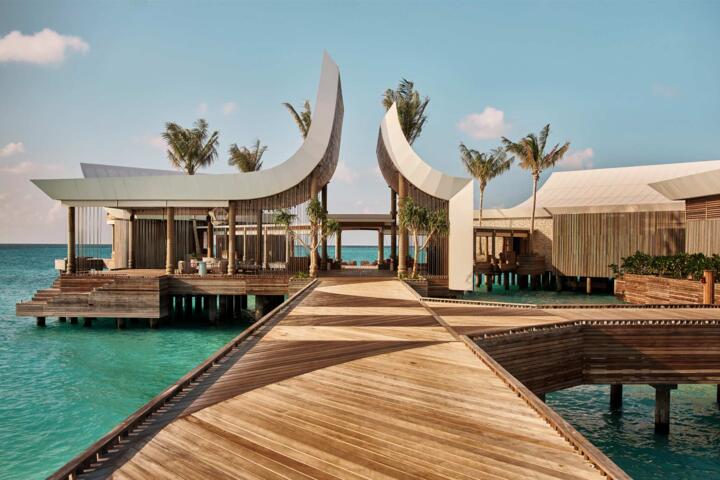
To maximize ROI under this limit, developers are increasingly using "Lightweight Architecture" which utilizes floating platforms. However, even these must be documented in the SMP. The 20% limit ensures that the "Robinson Crusoe" aesthetic, which commands a 30% premium in Room Rate (ADR), is preserved across the destination.
Vegetation Height Caps
Standard building height is strictly limited to two storeys, provided they are concealed by the island's natural vegetation. For uninhabited islands leased for resort development, this typically means a maximum height of 9 to 12 meters. In 2026, the only exception to this rule is found in "Integrated Tourism Zones" like Hulhumalé, where new regulations now allow up to 10 storeys (30.5 meters).
For a traditional resort, this cap forces a horizontal expansion strategy. Architects must design multi-unit villas that hug the ground to avoid breaking the skyline. Projects that attempt to "fudge" the height by planting taller non-native palms are now being flagged by satellite monitoring systems used by the Ministry of Tourism.
Beach Frontage Ratios
Each guest room must be allocated a minimum of 5 linear meters of beach frontage. Furthermore, only 68% of the total island beach length can be dedicated to guest accommodations. The remaining 32% is split: 20% for public use (beach clubs, spas) and 12% as protected open space. This prevents the "wall of villas" effect that characterizes lower-tier tropical destinations.
This ratio is a hard limit. If an island has a total perimeter of 1,000 meters, you are legally restricted to roughly 136 villas (assuming a 5-meter width). In 2026, the government is strictly enforcing these numbers to prevent the overcrowding that leads to nutrient loading in the surrounding house reefs.
Renewable Energy Mandates
As of 2026, any new resort development must generate at least 30% of its peak daytime power from renewable sources, primarily rooftop solar. The "Sustainability Management Plan" requires a detailed schematic showing how solar panels will be integrated into "Kadjan" (thatch) roofing or hidden within staff compound zones. Failure to hit this 30% mark results in higher "Green Tax" brackets for the operator.
This regulation has led to the rise of "Floating Solar" arrays in resort lagoons. While these do not count toward the 20% land build-up limit, they require separate ERA permits to ensure they do not shade critical seagrass beds or coral nurseries. The average 100-key resort now requires a 500kWp to 1MWp solar installation to meet 2026 compliance.
Waste Management Zoning
Every resort is now zoned as a "Self-Sustaining Waste Zone." You are prohibited from transporting non-recyclable waste to the "Thilafushi" industrial island without a premium disposal permit. Resorts must have an on-site glass crusher, a compost system for organic waste, and a plastic shredder. The physical footprint of these facilities must fit within the 20% buildable area.
In practice, developers are allocating 15% of their total "built-up" allowance to "Back of House" (BOH) infrastructure. In 2026, the Ministry has introduced a "Noise Zoning" rule, requiring a 50-meter buffer between high-decibel waste machinery and the nearest guest-facing structure, effectively further shrinking the available "luxury" footprint.
Reclamation Success Cases
The "Fari Islands" project in the North Malé Atoll serves as the gold standard for 2026 integrated zoning. The developers utilized four man-made islands within a single lagoon to host three distinct brands: Ritz-Carlton, Patina, and Capella. By centralizing the staff campus (Fari Village) on a fourth island, they optimized the build-up ratios across the luxury islands, allowing for larger guest villas while staying within the 20% limit per land mass.
Another case involves a boutique resort in the Raa Atoll that faced a permit denial due to "Beach Frontage" violations. By redesigning 40% of their keys as over-water villas—which in 2026 have more flexible frontage rules than land villas—the project reached its 80-key target without encroaching on the protected 12% open beach space. This pivot allowed the resort to open on schedule in February 2026 with a $1,200 ADR.
Zoning Standards 2026
| Parameter | Resort Limit | Urban Limit | Enforcement |
|---|---|---|---|
| Build Ratio | 20% Total | 60% Total | Strict |
| Max Height | 2 Floors | 10 Floors | Vertical |
| Beach Space | 68% Guest | N/A | Linear |
| Solar Req | 30% Peak | 15% Peak | Annual |
Common Legal Pitfalls
One of the most dangerous mistakes is assuming that "Lagoon Boundaries" are static. In the 2026 Tourism Act amendment, the boundaries of the lagoon are formally recognized, but land reclamation outside these coordinates is a criminal offense. Developers often try to extend "sandbanks" to create more land area, but if these banks interfere with local fishing routes or migratory paths, the ERA can order immediate demolition.
Another error is the "Staff Accommodation Slum." To save on the 20% built-up allowance, some developers under-design staff quarters. However, 2026 regulations mandate specific square footage and amenities (including AC and recreation) per staff member. If a resort fails a "Labour and Housing Audit," its operating license can be suspended, regardless of how many guests are currently checked in.
Finally, the "EIA Exemption" trap. While the 2026 rules allow warehouses and communication towers to bypass the EIA, this only applies if they are built on existing land. Any foundation work that touches the seabed—even for a small jetty—still requires a full environmental study. Over-reliance on the "new exemptions" has led many 2026 projects into legal gridlock.
FAQ
Are 10-storey resorts allowed?
Only in designated "Urban Tourism" zones like Hulhumalé. For standard uninhabited islands ("One Island, One Resort"), the limit remains two storeys or the height of the vegetation. Building above the tree line is prohibited to maintain the natural aesthetic of the atolls.
How is "Built-Up Area" calculated?
It is the total footprint of all permanent structures on land. This includes villas, restaurants, staff housing, and power plants. In 2026, the ERA is also beginning to count "hard-scaped" pathways and tennis courts toward this 20% limit if they use non-porous materials.
Can I reclaim more land?
Yes, but it requires a specific "Reclamation License" and a heavy EIA. In 2026, you must prove that the reclamation does not cause "Sediment Plumes" that damage neighboring reefs. Many developers are now required to use "Silt Curtains" and real-time turbidity monitoring during dredging.
What is the Green Tax in 2026?
The Green Tax is currently $6 per person per day for resorts. However, failing to meet the 30% solar energy mandate or waste management standards can trigger additional "Environmental Levies" that act as a surcharge on top of the standard tax, impacting the resort's competitiveness.
Are over-water villas limited?
Over-water villas are not strictly capped by the 20% land ratio, but they are limited by the "Lagoon Lease" area and the "Coral Cover" density. You cannot build over-water structures over "Category A" live coral reefs. A marine survey is required before any over-water plot plan is approved.
Author's Insight
In my decade of advising on Maldivian hospitality assets, I have seen the regulatory pendulum swing from "development at all costs" to the high-scrutiny environment of 2026. The most successful developers today are those who view the 20% build-up limit as a design challenge rather than a restriction. By investing heavily in "BOH" efficiency and modular construction, you can maximize guest space while remaining fully compliant. My biggest tip: never trust a 2024 survey for a 2026 project; the reefs and the regulations move too fast for old data.
Summary
Maldives resort development in 2026 is defined by the 20% built-up area cap, strict two-storey height limits, and mandatory 30% renewable energy integration. Developers must secure an ERA-approved Sustainability Management Plan and adhere to rigorous beach frontage ratios. To succeed, prioritize "Integrated Resort" models that share infrastructure and use over-water villas to bypass land density limits. Actionable advice: Conduct a high-resolution marine and land survey before finalizing any lease, as environmental compliance is now the primary gatekeeper for Maldivian tourism licenses.