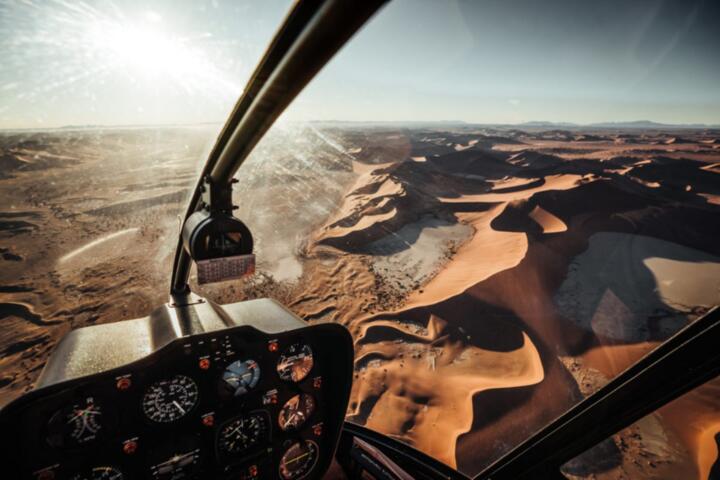
Aerial Safari Landscape
A flying safari is not merely a sightseeing flight; it is a sophisticated logistics operation that utilizes low-altitude aviation to bridge the gap between isolated luxury camps. In the Namib, this typically involves using turbine-powered helicopters, such as the Eurocopter AS350 (AStar), which offers superior performance in high-density altitude conditions. Unlike fixed-wing transfers, helicopters allow for "off-airport" landings, enabling guests to have sundowners on remote mountain ridges or touch down near the abandoned diamond mines of the Sperrgebiet.
Practically, an aerial itinerary compresses a two-week driving loop into a five-day flight circuit. For instance, the transit from Sossusvlei to the Skeleton Coast takes approximately 10 hours by road through harsh gravel plains; by helicopter, it is a 90-minute flight featuring a front-row seat to the meeting of the Atlantic Ocean and the Namib Sand Sea. Statistics from the Namibia Civil Aviation Authority (NCAA) indicate a 15% year-on-year increase in private charter requests, reflecting a shift toward time-sensitive, high-privacy travel.
Real-world data shows that temperature fluctuations in the Namib can range from 2°C at dawn to 45°C by midday. This affects lift and payload. Expert operators, such as Sossusvlei Helicopters or Scenic Air, strictly manage weight limits, often restricting luggage to 10–15kg in soft-sided bags to ensure the aircraft maintains optimal safety margins during vertical take-offs in heat.
Remote Aviation Planning
The most frequent error in planning a flying safari is underestimating the "Density Altitude" effect. Many travelers book standard tours without realizing that high temperatures significantly reduce air density, which in turn reduces engine performance and lift. Attempting to fly a fully loaded, underpowered piston helicopter in the midday heat of the Kuiseb Canyon is a safety risk that often leads to forced itinerary changes or cancelled legs.
Another major issue is the "scenic fatigue" caused by poor flight pathing. Without an expert pilot who understands photography angles and light direction, guests often find themselves looking into the sun or flying too high to appreciate the desert's intricate textures. This results in mediocre photographic results and a sense of disconnection from the landscape.
Logistical failures regarding fuel positioning are also common. The Namib is largely uninhabited; there are no "gas stations" for helicopters in the deep dunes. If an operator hasn't pre-staged fuel drums at remote strips like Purros or Terrace Bay, the helicopter's range is severely limited, forcing it to stick to well-trodden, less-spectacular routes. This negates the primary reason for hiring a private craft: total freedom of movement.
Flight Experience Solutions
Optimizing the Flight Window for Photography
To capture the iconic "knife-edge" shadows of the Big Daddy dune or the salt pans of Deadvlei, you must be airborne at civil twilight. This requires staying at lodges with private helipads, such as &Beyond Sosusvlei Desert Lodge. By launching at 06:15 AM, you hit the dunes exactly when the sun is at a 15-degree angle, providing the contrast needed for world-class imagery. Midday flights should be avoided as the overhead sun flattens the landscape and increases turbulence.
Selecting the Correct Aircraft for Terrain
For the Namib, the Bell 206 JetRanger or the Airbus H125 are industry standards. The H125 is particularly favored for its "hot and high" performance capabilities. When booking, insist on an aircraft with "doors-off" capabilities if photography is a priority. This eliminates glare from the Perspex windows and allows for unobstructed 180-degree views. Ensure the operator holds a valid Air Operator Certificate (AOC) specifically for Namibian airspace.
Integrating Ground-Based Conservation
A high-end safari should contribute to the ecosystem it surveys. Partner with operators who support the Giraffe Conservation Foundation (GCF) or the Desert Lion Conservation Trust. Aerial assets are frequently used for telemetry tracking of collared lions in the Hoanib River Valley. Incorporating a "conservation flight" where guests shadow a researcher allows for a deeper, more meaningful connection to the land beyond simple tourism.
Managing Payload and Logistics
Use a "Chase Vehicle" strategy for maximum comfort. While the guests fly, a dedicated 4x4 ground crew moves heavy luggage, premium catering, and spare fuel between destinations. This lightens the helicopter’s load, increasing its safety ceiling and maneuverability. This method is used by elite outfitters like Ultimate Safaris to ensure that when the helicopter lands in a remote valley, a full luxury setup is already waiting.
Navigating Weather and Coastal Fog
The Skeleton Coast is notorious for the "Advection Fog"—a thick maritime mist created by the cold Benguela Current meeting the hot desert air. Expert pilots utilize IFR (Instrument Flight Rules) capable equipment but often fly VFR (Visual Flight Rules) by following the coastline just under the ceiling. Always build a "weather day" into a 7-day itinerary to account for these coastal inversions which can ground flights for several hours.
Aviation Case Studies
Case Study 1: The Skeleton Coast Shipwreck Expedition
Client: A group of four professional wildlife photographers.
Challenge: Reaching the Eduard Bohlen shipwreck, which lies 400 meters inland, during the brief window of morning light before the fog rolls in.
Action: An Airbus H125 was positioned at Wolwedans. The pilot utilized satellite weather tracking to identify a 2-hour clear window. They flew a low-level coastal route at 500 feet AGL (Above Ground Level).
Result: The group captured 4k cinematic footage and high-res stills without window glare. The mission was completed 3 hours faster than a ground expedition, with 0% environmental impact on the sensitive lichen fields.
Case Study 2: Remote Himba Cultural Exchange
Client: A private family seeking an authentic cultural encounter in the Kunene Region.
Challenge: Accessing a nomadic Himba settlement that was 12 hours away from the nearest lodge by road.
Action: Using a helicopter, the family traveled from the Hoanib Skeleton Coast Camp to the Hartmann Valley in 45 minutes. The operator secured prior permission from the local Conservancy office.
Result: The family spent 4 hours with the community and returned to their lodge by sunset. The flight saved 24 hours of travel time, which was redirected into a donation to the local school fund.
Safari Transport Methods
| Feature | Helicopter (H125) | Fixed-Wing (C210) | 4x4 (Land Cruiser) |
|---|---|---|---|
| Accessibility | Landing anywhere | Airstrip only | Road/Track only |
| Speed | 240 km/h | 280 km/h | 40-60 km/h |
| Photography | Excellent (Hover) | Good (High wing) | Limited view |
| Daily Cost | $3,000 - $6,000+ | $1,500 - $3,000 | $500 - $1,200 |
Common Pitfalls
One major mistake is booking through a general travel agent rather than a specialized aviation safari outfitter. General agents often fail to account for "repositioning costs"—the price of flying the empty helicopter from its base in Windhoek to your starting lodge. To avoid this, look for operators with helicopters already stationed in the Sossusvlei or Swakopmund regions.
Ignoring the "No-Fly Zone" regulations can lead to heavy fines and permit revocations. Large portions of Namibia are protected National Parks (like the Namib-Naukluft). Pilots must maintain specific altitudes (usually 1,000 feet AGL) unless landing at designated spots. Always verify that your pilot has the "Low Level Permit" required for cinematic flight paths, as flying too low without one disturbs wildlife and violates local laws.
FAQ
What is the best time of year for a Namibian flying safari?
May to September is ideal. The air is cooler, which improves aircraft performance, and the visibility is crystal clear. During the summer (January-March), thermal turbulence can make for a bumpy ride in the afternoons.
How many people can fit in a private safari helicopter?
Most luxury helicopters like the H125 or Bell 407 comfortably seat 4 to 5 passengers. However, with heavy camera gear and luggage, 3 passengers is the "sweet spot" for weight and balance.
Are there luggage restrictions for these flights?
Yes. Due to space and weight limits, guests are usually restricted to 15kg in soft-sided duffel bags. Hard suitcases cannot be stowed in the small baggage compartments of most helicopters.
Is it possible to see the Desert Elephants from the air?
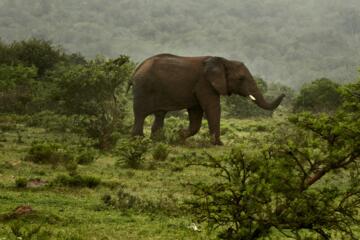
Yes, particularly in the Huab and Horusib riverbeds. An experienced pilot knows how to spot their tracks from above, but ethical guidelines require maintaining a distance that doesn't cause the animals stress.
Can we customize the route on the fly?
Within reason, yes. This is the main benefit of a private charter. If the pilot sees something interesting—like a whale carcass on the coast or a unique geological formation—they can divert, provided fuel reserves allow for it.
Author’s Insight
Having logged hundreds of hours planning logistics across Southern Africa, I’ve found that the "helicopter vs. vehicle" debate isn't about luxury; it's about access. In the Namib, the most soul-stirring landscapes are often hidden behind impassable mountain ranges or restricted diamond zones. My top recommendation is to use the helicopter as a "precision tool"—don't just fly from A to B, but use it to explore the inaccessible "C" in between. Always ask your pilot for a "low-and-slow" pass over the Conception Bay shipwrecks; it is a hauntingly beautiful sight that no ground vehicle will ever reach.
Summary
A private helicopter safari in the Namib Desert is the ultimate expression of modern exploration, blending high-tech aviation with raw, primordial nature. By prioritizing turbine aircraft performance, timing flights for optimal light, and respecting the delicate desert ecology, travelers can experience a version of Namibia that remains invisible to the traditional tourist. To maximize your investment, ensure your operator has deep local knowledge and the technical capability to manage the desert’s unique atmospheric challenges. The Namib is best understood not from the ground, but from the air, where the true scale of its 55-million-year-old dunes can be fully realized.